Science fiction · Adventure
20,000 Leagues Under the Sea
Reading level: we suggest CEFR B2 for reading 20,000 Leagues Under the Sea in English (it was first written in French). Length: about 140,000 words in English.
- Suggested levelB2
- Lengthabout 140,000 words in English
- Original languageFrench
The story
Ships around the world report a giant sea monster. Professor Pierre Aronnax joins an American warship to hunt it, and is thrown overboard with his servant Conseil and the harpooner Ned Land.
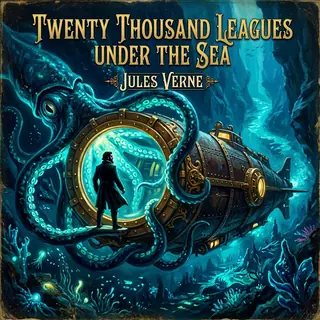
The “monster” is a submarine, the Nautilus, commanded by the mysterious Captain Nemo. As prisoners and guests, they travel under the oceans of the world — coral forests, Atlantis, the South Pole, giant squid — while Ned plans their escape.
Themes: science and the sea, freedom and revenge, exploration, technology.
Why it's a good book for language learners
Verne combines adventure with long scientific lists of fish, minerals and machines, so this is a goldmine for vocabulary. Conseil's obsession with classification is funny and helpful. In French, it is one of the most read classics in the world.
How hard is the English in 20,000 Leagues Under the Sea?
- Flesch Reading Ease70.3
- Flesch–Kincaid grade7.3
- Words per sentence15.6
Measured by PageWalker on the full English text of the book. Flesch Reading Ease runs from 0 to 100 (higher is easier; 60–70 is plain English) and the Flesch–Kincaid grade is a US school grade. These formulas only count sentence and word length, so they miss old-fashioned vocabulary, wordplay and style. That is why our CEFR level, which takes those into account, can be higher than the formula suggests.
What you'll practise
- Sea life and ocean vocabulary
- Science and technology words
- Describing people's motives
- Long descriptive passages
Reading tip
Skim the long lists of fish on first reading and come back to them later for vocabulary work.
Did you know?
A league is about 4 km; the title refers to the distance travelled under the sea, not the depth.
20,000 Leagues Under the Sea: a part-by-part guide
Contains spoilers. Read one part of the book, then come back to check you followed it.
Part One, Chapters 1–7: The hunt for the sea monster
In 1866, ships around the world report a huge, fast, glowing creature in the ocean. Pierre Aronnax, a professor from the Museum of Paris, believes it may be a giant narwhal. He joins the American frigate Abraham Lincoln, with his servant Conseil and the Canadian harpooner Ned Land, to hunt it. After months of searching, they find the creature and attack it. In the fight, Aronnax falls into the sea. Conseil jumps in after him, and they find Ned standing on the back of the 'monster'. It is made of metal.
Part One, Chapters 8–14: Prisoners of Captain Nemo
The 'monster' is a submarine called the Nautilus. Its commander, Captain Nemo, says he has left human society for ever. The three men may move around freely on board, but they can never leave. Nemo shows Aronnax his library, his museum of sea life and his paintings, and explains that the ship runs on electricity made from the sea. The Nautilus travels across the Pacific, following the Black River current near Japan. Nemo then invites his guests to go hunting in the underwater forests of the island of Crespo.
Part One, Chapters 15–23: Across the Pacific
Wearing diving-dresses, the men walk on the sea floor and through an underwater forest. Later, Nemo shows Aronnax the place at Vanikoro where the explorer La Perouse was wrecked. In the Torres Straits the Nautilus runs aground. The prisoners go ashore to hunt on an island, but local people attack them. Nemo protects his ship with an electric shock on its handrails. Soon after, the prisoners are put to sleep while something secret happens. A crewman is badly wounded and dies, and Nemo buries him in a coral cemetery under the sea.
Part Two, Chapters 1–7: From the Indian Ocean to the Mediterranean
Near Ceylon, Nemo takes his guests to see the pearl fisheries. When a shark attacks a poor Indian pearl diver, Nemo fights it with a dagger, and Ned kills it with his harpoon. Nemo gives the diver a bag of pearls. The Nautilus crosses the Red Sea, where Ned harpoons a dugong, and then passes into the Mediterranean through Nemo's secret Arabian Tunnel under the Isthmus of Suez. Near Crete, Aronnax sees Nemo send away a chest full of gold. The ship crosses the Mediterranean very quickly.
Part Two, Chapters 8–13: Treasures and wonders of the Atlantic
In Vigo Bay, Nemo's crew collect gold from old Spanish ships. Nemo says he uses this money to help suffering and oppressed people. At night he leads Aronnax across the sea bed to the ruins of Atlantis. The Nautilus visits a hidden harbour inside an extinct volcano, where the crew mine coal. It then passes through the calm Sargasso Sea. Nemo refuses to let Ned kill harmless whales, but he uses the ship's steel spur to destroy a group of fierce cachalots. Then the ship heads south among icebergs.
Part Two, Chapters 14–18: The South Pole and the giant squid
The Nautilus travels under the ice and reaches open water. On 21 March 1868, Nemo stands at the South Pole and claims it. On the way back, a falling iceberg traps the ship under the ice. For days the crew and the prisoners dig, while the air runs out. Ned and Conseil save Aronnax by giving him their last air. Finally the ship breaks through. Later, near the Bahamas, giant squids called poulps attack. One sailor is carried away, and Nemo saves Ned's life.
Part Two, Chapters 19–23: Revenge and escape
The Nautilus follows the Gulf Stream north. Nemo stops above the wreck of the French warship the Avenger, which sank rather than surrender. When a warship fires at the Nautilus, Nemo rams it and sinks it with all its crew. Afterwards Aronnax sees him crying in front of a picture of a woman and two children. The three prisoners decide to escape in the ship's small boat. As they leave, the Nautilus is caught in the maelstrom, a huge whirlpool off Norway. They wake up safe in a fisherman's hut in the Loffoden Isles.
Main characters
- Professor Pierre Aronnax: A French scientist from the Museum of Paris who tells the story and loves studying sea life.
- Conseil: Aronnax's calm and loyal Flemish servant, who loves putting animals into scientific groups.
- Ned Land: A strong and quick-tempered Canadian harpooner who wants freedom more than anything.
- Captain Nemo: The mysterious commander of the Nautilus, a brilliant but angry man who has left life on land behind.
- Commander Farragut: The captain of the American frigate Abraham Lincoln, which hunts the 'monster' at the start of the book.
Words to learn from 20,000 Leagues Under the Sea
Each example sentence is copied from the book, so you will meet these words in exactly this form.
| Word | Meaning | In the book |
|---|---|---|
| harpoon | a long spear on a rope, thrown to catch whales or big fish | they desired nothing better than to meet the unicorn, to harpoon it, hoist it on board, and despatch it. |
| reef | a line of rock or coral just under or near the sea surface | The monster became a small island, a rock, a reef, but a reef of indefinite and shifting proportions. |
| submarine | a ship or boat that can travel under the water | But, how admit that the construction of this submarine boat had escaped the public eye? |
| coral | a hard material made by tiny sea animals that forms reefs and islands | These are coral islands, slowly raised, but continuous, created by the daily work of polypi. |
| iceberg | a very large piece of ice floating in the sea | Ned Land, who had fished in the Arctic Seas, was familiar with its icebergs; but Conseil and I admired them for the first time. |
| whirlpool | water that turns round and round very fast and pulls things down | rush with irresistible violence, forming a whirlpool from which no vessel ever escapes. |
| tentacles | the long soft arms of animals like squid and octopus | Of their eight tentacles, six were elongated, and stretched out floating on the water |
| pressure | the force of something pressing on a surface, like deep water | Because it requires incalculable strength to keep one’s self in these strata and resist their pressure. |
| suffocated | unable to breathe because there is not enough air | When I went back on board, I was half suffocated. |
| shipwreck | a ship that has been destroyed or sunk at sea | We were dumb; our hearts beat fast before this shipwreck, taken as it were from life and photographed in its last moments. |
| current | a strong movement of water in one direction in the sea | It was this current that the Nautilus was to follow. |
| diving-dress | a special suit with air that lets a person walk under water | other animals more to be feared might haunt these obscure depths, against whose attacks my diving-dress would not protect me. |
Famous lines
I am not what you call a civilised man! I have done with society entirely, for reasons which I alone have the right of appreciating.
The sea is everything. It covers seven-tenths of the terrestrial globe.
There only is independence! There I recognise no masters! There I am free!
That Indian, sir, is an inhabitant of an oppressed country; and I am still, and shall be, to my last breath, one of them!
and I heard him murmur these words (the last which ever struck my ear): “Almighty God! enough! enough!”
“That which is far off and exceeding deep, who can find it out?” two men alone of all now living have the right to give an answer
Questions for discussion
Good for a book club, a class, or writing practice: answer one question in five sentences.
- Captain Nemo says the prisoners are free on the Nautilus, but they can never leave. Are they really free? Why or why not?
- Do you think Captain Nemo is a hero, a villain or something in between? Use events from the book to explain your answer.
- Ned Land, Conseil and Aronnax feel very differently about life on the Nautilus. Which of the three would you be most like, and why?
- Nemo refuses to kill harmless whales but attacks the cachalots and sinks a warship full of men. How can you explain these different actions?
- Jules Verne imagined an electric submarine long before real ones could do these things. Which of his ideas came true, and which still feel like fantasy?
- At the end, Aronnax does not know what happened to Nemo. Why do you think the author left the ending open, and what do you think happened?
The PageWalker adventure
In the adventure you are Aronnax aboard the Nautilus — choose between Nemo's world and Ned's escape plan. You can try the first page in your browser, and the adventure is available in 13 languages with click-to-translate.
20,000 Leagues Under the Sea in other languages
- English20,000 Leagues Under the Sea
- العربية20،000 فرسخ تحت الماء
- Deutsch20.000 Meilen unter dem Meer
- Español20.000 Leguas de Viaje Submarino
- FrançaisVingt Mille Lieues sous les mers
- हिन्दीसमुद्र के नीचे 20,000 लीग
- ItalianoVentimila leghe sotto i mari
- 日本語海底二万里
- 한국어해저 2만 리
- PortuguêsVinte Mil Léguas Submarinas
- Русский20 000 лье под водой
- TürkçeDenizler Altında 20.000 Fersah
- 简体中文海底两万里
Questions about 20,000 Leagues Under the Sea
What reading level is 20,000 Leagues Under the Sea?
We suggest CEFR B2 for reading 20,000 Leagues Under the Sea in English (it was first written in French). Verne combines adventure with long scientific lists of fish, minerals and machines, so this is a goldmine for vocabulary. On readability formulas the English text scores a Flesch Reading Ease of 70.3 and a Flesch–Kincaid grade of 7.3, with an average of 15.6 words per sentence.
How long is 20,000 Leagues Under the Sea?
20,000 Leagues Under the Sea by Jules Verne (1870) is about 140,000 words in English.
Can I play 20,000 Leagues Under the Sea as an interactive adventure?
Yes. In the adventure you are Aronnax aboard the Nautilus — choose between Nemo's world and Ned's escape plan. You can try the first page in your browser, in 13 languages.
Updated 16 October 2026