Science fiction · Adventure
Journey to the Center of the Earth
Reading level: we suggest CEFR B2 for reading Journey to the Center of the Earth in English (it was first written in French). Length: about 85,000 words in English.
- Suggested levelB2
- Lengthabout 85,000 words in English
- Original languageFrench
The story
Professor Otto Lidenbrock decodes a runic message that points to a path into the Earth through the crater of an Icelandic volcano. His nervous nephew Axel has no choice but to come along, with their calm guide Hans.
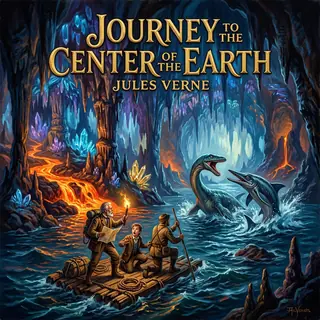
Underground they find giant mushrooms, an inland sea, prehistoric creatures and finally a ride back to the surface that nobody could have planned.
Themes: scientific curiosity, courage, deep time, exploration.
Why it's a good book for language learners
Verne loves explaining, so you will meet clear descriptions of geology, measurements and equipment alongside the adventure. Axel's fear and his uncle's enthusiasm make a funny, human pair. In French, this is one of the most popular classics for learners.
How hard is the English in Journey to the Center of the Earth?
- Flesch Reading Ease68.7
- Flesch–Kincaid grade7.6
- Words per sentence15.9
Measured by PageWalker on the full English text of the book. Flesch Reading Ease runs from 0 to 100 (higher is easier; 60–70 is plain English) and the Flesch–Kincaid grade is a US school grade. These formulas only count sentence and word length, so they miss old-fashioned vocabulary, wordplay and style. That is why our CEFR level, which takes those into account, can be higher than the formula suggests.
What you'll practise
- Geology and landscape vocabulary
- Numbers, measurements and directions
- Expressing fear, doubt and persuasion
- Future and conditional plans
Reading tip
Keep a simple map of the route as you read: Hamburg, Iceland, Snæfellsjökull, and then down.
Did you know?
The book appeared in 1864, during a period of intense public interest in fossils and the age of the Earth.
Journey to the Center of the Earth: a part-by-part guide
Contains spoilers. Read one part of the book, then come back to check you followed it.
This guide follows the early English translation that PageWalker uses. In most other translations the narrator is called Axel, his uncle is Professor Otto Lidenbrock and Gretchen is Graüben.
Chapters 1–5: The secret message
In Hamburg, Professor Hardwigg finds a small piece of parchment inside an old Icelandic book. It is covered in strange letters, and he refuses to eat until he understands it. His nephew Harry, hungry and tired, discovers by accident that the message must be read backwards. It is a Latin note by Arne Saknussemm, who says he reached the centre of the earth through a volcano in Iceland. The Professor decides to go at once. Gretchen encourages Harry, and in Copenhagen his uncle makes him climb a church tower to cure his fear of heights.
Chapters 6–13: Iceland and Mount Sneffels
Harry and his uncle sail to Iceland on the ship Valkyrie. In Reykjavik, Professor Fridriksson tells them that Saknussemm's books were burnt in 1573. The Professor hires Hans, a calm and very strong eider-duck hunter, as their guide. The three men ride across the island to the village of Stapi and then climb Mount Sneffels. Inside the crater there are three openings. They wait for days until, on 28 June, the shadow of the peak Scartaris falls on one of them and shows them the right way down.
Chapters 14–22: Into the earth
The travellers go down the dark shaft with ropes and follow tunnels of old lava. They choose the eastern tunnel, but it is the wrong road, and their water runs out. They must walk back for days, and Harry nearly dies of thirst. In the western tunnel, Hans hears water behind a rock wall and opens it with a pickaxe. They call the hot stream the Hansbach. Following it, they travel deeper, even under the ocean, and rest on a Sunday in a huge cave.
Chapters 23–26: Lost in the dark
Harry walks ahead alone and loses the stream and his companions. He is in total darkness, with no water and no light, and he feels buried alive. After a long time he hears voices through the rock. In a 'whispering gallery', sound travels along the walls, so he can talk with his uncle, who is far away. The Professor tells him to go down. Harry falls down a steep shaft and wakes up safe with his uncle and Hans, near the sound of waves.
Chapters 27–32: The Central Sea
Harry walks out of a cave and sees a huge underground sea, lit by a strange electric light. There is a forest of giant mushrooms on the shore. Hans builds a raft from fossil wood, and they leave from a place Harry names Port Gretchen. On the sea they watch two enormous ancient reptiles fight, and they pass an island with a great geyser. Then a terrible storm comes. A ball of fire passes over the raft, and the wind drives them for days until they crash on a rocky shore.
Chapters 33–38: Bones, giants and a dagger
Hans saves Harry from the waves. The compass shows that the storm has carried them back towards the coast they left. Exploring, they find a huge plain of bones and an ancient human skull. In a forest they see living mastodons and a giant human shepherd more than twelve feet tall, and they run away. Then Harry finds a rusty old dagger, and they see the letters A. S. cut in the rock. Saknussemm's tunnel is blocked by a great rock, so they decide to blow it up.
Chapters 39–44: Up through the volcano
The explosion opens a deep hole, and the sea rushes into it, carrying the raft down at great speed. Most of their food and tools are lost. Harry dreams of a giant ape, and the travellers suffer terrible hunger. Then boiling water and lava push the raft up a volcanic shaft. They are thrown out onto a mountain in the sunshine and learn that they are on Stromboli, in Italy. Back in Hamburg, the Professor becomes famous, Hans returns to Iceland, the mystery of the compass is solved, and Harry marries Gretchen.
Main characters
- Harry: The young English narrator, also called Henry, who studies minerals with his uncle and is often afraid on the journey.
- Professor Hardwigg: Harry's clever, impatient and very determined uncle, a professor in Hamburg who leads the expedition.
- Hans: A quiet, strong Icelandic eider-duck hunter who works as their guide and saves their lives many times.
- Gretchen: The Professor's young god-daughter, who loves Harry and encourages him to be brave.
- Arne Saknussemm: A learned Icelander of long ago whose secret message says he reached the centre of the earth.
- Professor Fridriksson: A kind professor in Reykjavik who welcomes the travellers and tells them about Saknussemm.
Words to learn from Journey to the Center of the Earth
Each example sentence is copied from the book, so you will meet these words in exactly this form.
| Word | Meaning | In the book |
|---|---|---|
| parchment | old writing material made from animal skin | I was about to venture upon some misplaced joke on the subject, when a small scrap of parchment fell out of the leaves. |
| crater | the large round hole at the top of a volcano | We are about to pay a visit to the very bottom of the crater. |
| descend | to go down | We were about to descend farther into the interior of the earth. |
| provisions | food and other supplies taken on a journey | Next day, June 23d, Hans calmly awaited us outside the presbytery with his three companions loaded with provisions, tools, and instruments. |
| guide | a person who shows others the way | Hans, our extraordinary guide, went first, walking with a steady, rapid, unvarying step. |
| abyss | a very deep hole that seems to have no bottom | I had not as yet ventured to take a glimpse down the horrible abyss into which in a few minutes more I was about to plunge. |
| compass | a tool with a needle that shows north and south | My uncle made several pauses in order to consult his compass. |
| thirst | the strong feeling that you need to drink | This beneficent spring after having saved us from thirst during so many days would now enable me to regain the right road. |
| courage | the ability to do something brave even when you are afraid | Hitherto our courage and determination had overcome all difficulties. |
| raft | a flat boat made of pieces of wood tied together | The very next evening, thanks to the industry and ability of Hans, the raft was finished. |
| astonishment | very great surprise | I turned to my uncle, silent with astonishment and awe. |
| explosion | a sudden loud burst, for example of gunpowder | As to the terrific roar of the explosion, I do not think I heard it. |
Famous lines
Descend into the crater of Yocul of Sneffels, which the shade of Scartaris caresses, before the kalends of July, audacious traveler, and you will reach the centre of the earth.
What a magnificent journey. If I were only a man! A journey worthy of the nephew of Professor Hardwigg.
No future navigator will deny the fact of my having discovered it; and hence of acquiring a right of giving it a name.
"A. S.!" cried my uncle. "You see, I was right. Arne Saknussemm, always Arne Saknussemm!"
Hunger, prolonged, is temporary madness! The brain is at work without its required food, and the most fantastic notions fill the mind.
"Now then, Harry, that you really are a hero," she said, "there is no reason why you should ever leave me again."
Questions for discussion
Good for a book club, a class, or writing practice: answer one question in five sentences.
- Harry is often afraid, but he goes on the journey anyway. Why do you think he goes, and does he change by the end?
- Professor Hardwigg never wants to turn back. Is he a good leader, or is he too stubborn? Give examples.
- Hans says very little and asks only for his weekly pay. What does the story show us about him through his actions?
- Which moment underground did you find the most frightening or the most wonderful, and why?
- The travellers name places after people they love, like Port Gretchen and the Hansbach. Why do you think explorers do this?
- Many people in Hamburg do not believe the story. If a friend told you about a journey like this, what would make you believe it?
The PageWalker adventure
In the adventure you choose the tunnels — and some of them do not lead back up. You can try the first page in your browser, and the adventure is available in 13 languages with click-to-translate.
Journey to the Center of the Earth in other languages
- EnglishJourney to the Center of the Earth
- العربيةرحلة إلى مركز الأرض
- DeutschDie Reise zum Mittelpunkt der Erde
- EspañolViaje al Centro de la Tierra
- FrançaisVoyage au centre de la Terre
- हिन्दीपृथ्वी के केंद्र की यात्रा
- ItalianoViaggio al centro della Terra
- 日本語地底旅行
- 한국어지구 속 여행
- PortuguêsViagem ao Centro da Terra
- РусскийПутешествие к центру Земли
- TürkçeDünyanın Merkezine Yolculuk
- 简体中文地心游记
Questions about Journey to the Center of the Earth
What reading level is Journey to the Center of the Earth?
We suggest CEFR B2 for reading Journey to the Center of the Earth in English (it was first written in French). Verne loves explaining, so you will meet clear descriptions of geology, measurements and equipment alongside the adventure. On readability formulas the English text scores a Flesch Reading Ease of 68.7 and a Flesch–Kincaid grade of 7.6, with an average of 15.9 words per sentence.
How long is Journey to the Center of the Earth?
Journey to the Center of the Earth by Jules Verne (1864) is about 85,000 words in English.
Can I play Journey to the Center of the Earth as an interactive adventure?
Yes. In the adventure you choose the tunnels — and some of them do not lead back up. You can try the first page in your browser, in 13 languages.
Updated 16 October 2026