Science fiction
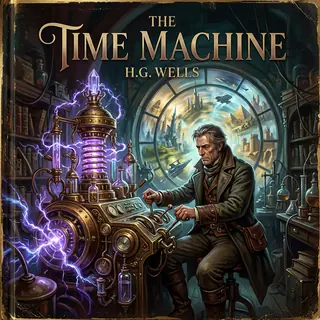
The Time Machine
Reading level: we suggest CEFR B2 for reading The Time Machine. Length: about 32,000 words.
- Suggested levelB2
- Lengthabout 32,000 words
- Original languageEnglish
The story
A Victorian inventor tells his dinner guests that he has travelled through time. In the year 802,701 he found the gentle, childlike Eloi living in a garden-like world — and soon discovered what lived beneath it.
His time machine is stolen, and to get it back he must go down into the darkness of the Morlocks before travelling even further, to the last days of the Earth.
Themes: time and evolution, social class, the future of humanity, science.
Why it's a good book for language learners
The Time Machine is short, and Wells's English is precise and modern for its age. It is a perfect first classic of science fiction, and its ideas about class and the future give you plenty to talk or write about.
How hard is the English in The Time Machine?
- Flesch Reading Ease72.2
- Flesch–Kincaid grade7.3
- Words per sentence16.5
Measured by PageWalker on the full English text of the book. Flesch Reading Ease runs from 0 to 100 (higher is easier; 60–70 is plain English) and the Flesch–Kincaid grade is a US school grade. These formulas only count sentence and word length, so they miss old-fashioned vocabulary, wordplay and style. That is why our CEFR level, which takes those into account, can be higher than the formula suggests.
What you'll practise
- Time expressions and tenses
- Scientific explanation
- Describing landscapes and creatures
- Hypotheses and speculation
Reading tip
Pay attention to how the Time Traveller changes his theory of the future three times as he learns more.
Did you know?
The novel made the phrase “time machine” part of everyday language.
The Time Machine: a part-by-part guide
Contains spoilers. Read one part of the book, then come back to check you followed it.
Chapters 1–2: An Impossible Idea
After dinner, the Time Traveller tells his guests that time is a fourth dimension, just like length, width and height. Filby and the others argue with him. Then he shows them a small model machine. The Psychologist presses its lever, and the model disappears. The Traveller says it has gone into the past or the future. He also shows them a bigger Time Machine, not yet finished, in his laboratory, and says he intends to explore time. The guests do not know whether to believe him.
Chapters 3–4: The Traveller Returns
The next Thursday the guests meet again for dinner, but their host is late. At last he walks in, dirty, tired and limping. He eats hungrily and then begins his story. He describes starting the machine in his laboratory and watching days and nights rush past faster and faster. When he stops, the machine falls over in a hailstorm. He is on a lawn far in the future, beside a huge white stone sphinx. Small, graceful people come running towards him.
Chapters 5–7: The Golden Age
The future people are small, beautiful and friendly, but they are weak and lose interest in things very quickly, like children. They eat only fruit and live together in large old buildings. The world looks like a peaceful garden, and the Traveller thinks humans have solved their problems and grown weak from an easy life. Then, by moonlight, he discovers that his Time Machine has gone. After a terrible night, he finds marks showing that it was dragged into the bronze base of the White Sphinx.
Chapters 8–10: Weena and the Underworld
The Traveller saves a little woman called Weena from drowning, and she becomes his loving friend. She is terribly afraid of the dark. He sees pale, ape-like creatures at night and finds deep wells all over the land. He climbs down one and meets the Morlocks, who live underground among machines, and he sees meat there. He escapes back up. Slowly he understands that the Morlocks feed on the Eloi, and he decides to find weapons and a safe place before the dark nights come.
Chapters 11–12: The Palace and the Forest Fire
With Weena, the Traveller reaches the Palace of Green Porcelain, a ruined museum full of dust, old machines and rotten books. He breaks off an iron lever to use as a weapon and finds matches and camphor. On the way back they must cross a dark forest at night. Morlocks attack them. He makes a fire, but falls asleep, and wakes with Morlocks all over him. His first fire grows into a huge forest fire. He fights his way out, but Weena is lost.
Chapters 13–14: The Trap and the Further Vision
That evening the bronze doors of the Sphinx are open, and the Time Machine is inside. It is a trap, and the doors close behind him. His matches will not light without their box, but he fights off the Morlocks in the dark and escapes on the machine. By mistake he travels far forward. He sees a huge red sun over a quiet sea and giant crabs on the beach. More than thirty million years later, the world is cold and almost lifeless, and he watches an eclipse.
Chapters 15–16 and Epilogue: The Last Journey
The Traveller returns to his laboratory on the same evening and joins his guests. Most of them do not believe his story, though he shows them two strange white flowers that Weena put in his pocket. The next day the narrator visits again. The Traveller, carrying a camera and a knapsack, promises to bring proof and goes into his laboratory. Moments later, he and the machine have vanished. Three years later he has still not returned, and the narrator keeps the flowers and wonders where he went.
Main characters
- The Time Traveller: A clever English scientist and inventor who builds a machine to travel through time and tells the story of his journey.
- The narrator: One of the Traveller's dinner guests, whose name we never learn, who reports the evenings and the Traveller's story.
- Weena: A small, gentle Eloi woman whom the Traveller saves from drowning and who becomes his close friend.
- The Eloi: The beautiful, childlike people of the future who live above ground, eat fruit and are afraid of the dark.
- The Morlocks: Pale, ape-like people of the future who live underground, hate light and hunt the Eloi at night.
- The dinner guests: Filby, the Medical Man, the Psychologist, the Editor and others, who listen to the Traveller's ideas and mostly doubt them.
Words to learn from The Time Machine
Each example sentence is copied from the book, so you will meet these words in exactly this form.
| Word | Meaning | In the book |
|---|---|---|
| lever | a handle or bar that you push or pull to make a machine work | I am going to press the lever, and off the machine will go. |
| frail | weak and easily hurt or broken | He struck me as being a very beautiful and graceful creature, but indescribably frail. |
| gratitude | the feeling of being thankful to someone | I had got to such a low estimate of her kind that I did not expect any gratitude from her. |
| species | a group of living things of the same kind | that Man had not remained one species, but had differentiated into two distinct animals |
| descendants | people who come after you in your family, like children and grandchildren | Very inhuman, you may think, to want to go killing one’s own descendants! |
| ruin | a state of being badly damaged or falling down | I found the Palace of Green Porcelain, when we approached it about noon, deserted and falling into ruin. |
| weapon | something you use to fight or protect yourself | For now I had a weapon indeed against the horrible creatures we feared. |
| exhausted | extremely tired | I walked slowly, for I was almost exhausted, as well as lame |
| desolate | empty, lonely and sad, with no people or life | Still slower, until the dim outlines of a desolate beach grew visible. |
| eclipse | when the sun's light is blocked by the moon or a planet | and then I realised that an eclipse was beginning. |
| incredible | impossible or very hard to believe | that all this will be absolutely incredible to you, but to me the one incredible thing is that I am here tonight in this old familiar room |
| vanished | disappeared suddenly and completely | The Time Traveller vanished three years ago. |
Famous lines
Can you imagine what I felt as this conviction came home to me? But you cannot. The Time Machine was gone!
It is a law of nature we overlook, that intellectual versatility is the compensation for change, danger, and trouble.
I grieved to think how brief the dream of the human intellect had been. It had committed suicide.
Take it as a lie—or a prophecy. Say I dreamed it in the workshop.
What a pity it is you’re not a writer of stories!
to witness that even when mind and strength had gone, gratitude and a mutual tenderness still lived on in the heart of man.
Questions for discussion
Good for a book club, a class, or writing practice: answer one question in five sentences.
- Why do you think the guests find it so hard to believe the Time Traveller, even when he shows them the model and the flowers?
- The Traveller changes his ideas about the future world several times. What does this tell us about making quick judgements?
- How are the Eloi and the Morlocks different, and what do you think Wells wanted to say about rich and poor people in his own time?
- Why is Weena so important to the Traveller, and how did you feel when she was lost in the forest?
- What does the Traveller's journey to the dying world, with its red sun and silent beach, make you think about the future of the Earth?
- Where do you think the Time Traveller went at the end of the book, and would you choose to travel to the past or the future?
The PageWalker adventure
In the adventure you choose how to survive in 802,701 — and how to get your machine back. You can try the first page in your browser, and the adventure is available in 13 languages with click-to-translate.
The Time Machine in other languages
- EnglishThe Time Machine
- العربيةآلة الزمن
- DeutschDie Zeitmaschine
- EspañolLa Máquina del Tiempo
- FrançaisLa Machine à explorer le temps
- हिन्दीद टाइम मशीन
- ItalianoLa macchina del tempo
- 日本語タイム・マシン
- 한국어타임머신
- PortuguêsA Máquina do Tempo
- РусскийМашина времени
- TürkçeZaman Makinesi
- 简体中文时间机器
Questions about The Time Machine
What reading level is The Time Machine?
We suggest CEFR B2 for reading The Time Machine. The Time Machine is short, and Wells's English is precise and modern for its age. On readability formulas the English text scores a Flesch Reading Ease of 72.2 and a Flesch–Kincaid grade of 7.3, with an average of 16.5 words per sentence.
How long is The Time Machine?
The Time Machine by H. G. Wells (1895) is about 32,000 words.
Can I play The Time Machine as an interactive adventure?
Yes. In the adventure you choose how to survive in 802,701 — and how to get your machine back. You can try the first page in your browser, in 13 languages.
Updated 16 October 2026