Adventure · Survival
Robinson Crusoe
Reading level: we suggest CEFR B2–C1 for reading Robinson Crusoe. Length: about 120,000 words.
- Suggested levelB2–C1
- Lengthabout 120,000 words
- Original languageEnglish
The story
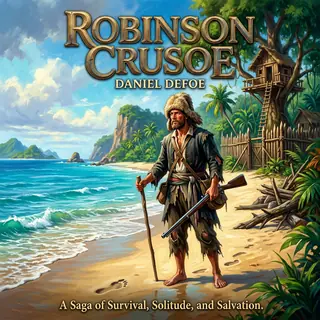
Against his father's advice, Robinson Crusoe goes to sea. After pirates, slavery and a plantation in Brazil, he is shipwrecked as the only survivor on an island near the mouth of the Orinoco.
For twenty-eight years he builds a life alone: a fortified home, crops, goats, a calendar cut into a post — until one day he finds a single human footprint in the sand.
Themes: self-reliance, faith, isolation, colonialism.
Why it's a good book for language learners
Defoe's English is nearly three hundred years old, with long sentences and some old spelling, so this is a book for confident readers. The reward is very concrete vocabulary: tools, food, weather and work, described in careful detail day by day.
How hard is the English in Robinson Crusoe?
- Flesch Reading Ease48.1
- Flesch–Kincaid grade18.8
- Words per sentence49.5
Measured by PageWalker on the full English text of the book. Flesch Reading Ease runs from 0 to 100 (higher is easier; 60–70 is plain English) and the Flesch–Kincaid grade is a US school grade. These formulas only count sentence and word length, so they miss old-fashioned vocabulary, wordplay and style. That is why our CEFR level, which takes those into account, can be higher than the formula suggests.
What you'll practise
- Daily routines and work vocabulary
- Lists and practical description
- 18th-century sentence structure
- Diary and journal style
Reading tip
Crusoe keeps a journal for part of the book. Keep your own short reading journal in your target language alongside it.
Did you know?
It is often called the first English novel, and it was a bestseller from the year it appeared.
Robinson Crusoe: a part-by-part guide
Contains spoilers. Read one part of the book, then come back to check you followed it.
A young man who wants the sea
Robinson Crusoe is born in York in 1632. His father wants him to live a safe, quiet life in the middle state, neither rich nor poor, and warns him against going to sea. Robinson does not listen. In 1651 he leaves home and sails from Hull without telling his parents. A terrible storm almost sinks the ship, and he is afraid, but soon he forgets his fear. He makes a trading voyage to the coast of Guinea in Africa and earns some money.
Slavery, escape and Brazil
On his next voyage, pirates from Sallee in North Africa capture the ship, and Robinson becomes a slave for about two years. One day he escapes in a small boat with a boy called Xury. They sail south along the African coast, where they see wild animals and meet friendly local people. A Portuguese captain picks them up and takes them to Brazil. Robinson buys land and learns how sugar is made and builds a successful plantation there, growing tobacco.
Shipwreck and survival
After almost four years in Brazil, Robinson joins a voyage to Africa to buy slaves. On the 1st of September 1659 the ship leaves, and a great storm drives it off course. The ship is wrecked near an unknown island and everyone except Robinson drowns. He swims to the shore. Then he builds a raft and makes many trips to the wreck to bring back food, tools, guns, powder, clothes and books. A dog and two cats from the ship also come with him.
Building a life alone
Robinson builds a strong fence around his tent and a cave, and he keeps a journal. He writes a list of the bad and good things in his situation and decides he has much to be thankful for. He becomes very ill with fever, has a frightening dream and starts to read the Bible and pray. Slowly he learns to grow barley and rice, make pots, bake bread, tame goats and teach his parrot Poll to speak.
The footprint and the cannibals
After many years, Robinson tries to sail around the island, but the current nearly carries him out to sea. Later, one day, he finds the print of a man's naked foot on the sand and is terribly afraid. He hides, builds more defences and finds a second cave. He discovers human bones on the shore and understands that cannibals from the mainland sometimes visit the island to kill and eat their prisoners. Later he also sees a Spanish ship wrecked near the island, but finds no survivors.
Friday
In about his twenty-fifth year on the island, Robinson saves a young prisoner who is running away from the cannibals. He names him Friday, after the day he saved his life. Friday becomes his loyal servant and friend. Robinson teaches him English, how to use a gun and about God. Later the cannibals bring more prisoners. Robinson and Friday rescue a Spaniard and an old man, who turns out to be Friday's father. Both men then go to the mainland to bring back more Spaniards.
The mutineers and rescue
In his twenty-eighth year, an English ship arrives. Its sailors have mutinied, and they bring their captain and two other men to the island as prisoners. Robinson and Friday free the captain, and together they defeat the rebels and take back the ship. The worst mutineers stay behind on the island. On the 19th of December 1686, after twenty-eight years, two months and nineteen days on the island, Robinson finally leaves with Friday and reaches England in June 1687.
Home, riches and a last visit
In England, Robinson finds that his parents are dead. He travels to Lisbon and meets the old Portuguese captain, who helps him get the money from his Brazilian plantation, and he becomes rich. He returns to England by land with Friday. In the snowy mountains between Spain and France, Friday plays a funny game with a bear before he kills it, and the group fights off a huge pack of wolves. Later Robinson marries, has three children and, after his wife dies, visits his island again.
Main characters
- Robinson Crusoe: The narrator, an Englishman from York who ignores his father's advice, goes to sea and spends over twenty-eight years alone on an island.
- Friday: A young man Robinson saves from cannibals, who becomes his faithful servant, student and friend.
- Robinson's father: A careful merchant who begs his son to stay home and live a quiet, safe life.
- Xury: A boy who escapes from slavery in Sallee with Robinson and helps him on the African coast.
- The Portuguese captain: An honest sea captain who rescues Robinson at sea and later helps him recover his wealth from Brazil.
- The Spaniard: A prisoner of the cannibals whom Robinson and Friday save and who later goes to fetch other Spaniards from the mainland.
- Friday's father: An old man rescued from the cannibals at the same time as the Spaniard, to Friday's great joy.
- The English captain: The commander of a ship whose crew mutinies, who takes back his ship with Robinson's help and carries him home.
Words to learn from Robinson Crusoe
Each example sentence is copied from the book, so you will meet these words in exactly this form.
| Word | Meaning | In the book |
|---|---|---|
| wreck | the broken remains of a ship that has been destroyed at sea | I now gave over any more thoughts of the ship, or of anything out of her, except what might drive on shore from her wreck |
| raft | a flat boat made by tying pieces of wood together | My raft was now strong enough to bear any reasonable weight. |
| ammunition | bullets and gunpowder used in guns | My next care was for some ammunition and arms. |
| journal | a book where you write what happens each day | And now it was that I began to keep a journal of every day’s employment |
| harvest | the time when crops are cut and collected from the fields | about the latter end of December, which was our second harvest of the year, I reaped my corn. |
| tame | not wild; used to living with people | This was the first time that I entertained a thought of breeding up some tame creatures, that I might have food when my powder and shot was all spent. |
| parrot | a colourful tropical bird that can learn to copy human words | I did, after some painstaking, catch a young parrot, for I knocked it down with a stick |
| canoe | a long, narrow boat moved with paddles | The boat was really much bigger than ever I saw a canoe or periagua, that was made of one tree, in my life. |
| cannibals | people who eat human flesh | I had heard that the people of the Caribbean coast were cannibals or man-eaters |
| deliverance | being saved or set free from danger or trouble | This moment my former notions of deliverance darted into my thoughts, for now I found I was likely to have a little ship at my command |
| Providence | God's care and control over what happens in people's lives | I rejected the voice of Providence, which had mercifully put me in a posture or station of life wherein I might have been happy and easy |
| plantation | a large farm in a hot country where crops like sugar are grown | I call him my neighbour, because his plantation lay next to mine, and we went on very sociably together. |
Famous lines
I went on board in an evil hour, the 1st September 1659, being the same day eight years that I went from my father and mother at Hull
But I am alive; and not drowned, as all my ship’s company were.
Poor Robin Crusoe! Where are you? Where have you been? How came you here?
I was exceedingly surprised with the print of a man’s naked foot on the shore, which was very plain to be seen on the sand.
I let him know his name should be Friday, which was the day I saved his life; I called him so for the memory of the time.
When I came to England I was as perfect a stranger to all the world as if I had never been known there.
Questions for discussion
Good for a book club, a class, or writing practice: answer one question in five sentences.
- Robinson's father tells him that a quiet middle life is the happiest. Do you agree with him? Why or why not?
- When Robinson writes his list of good and bad things, how does it change the way he feels? Could this idea help people today?
- Which skill that Robinson learns on the island do you think was the most important for his survival, and why?
- Why is Robinson so frightened by one footprint after so many years of wanting company?
- How would you describe the relationship between Robinson and Friday? What do you think of the way Robinson treats him?
- If you were left alone on an island for many years, what would you miss most, and how would you keep your mind healthy?
The PageWalker adventure
In the adventure you make Crusoe's survival choices — and some mistakes on the island cannot be undone. You can try the first page in your browser, and the adventure is available in 13 languages with click-to-translate.
Robinson Crusoe in other languages
- EnglishRobinson Crusoe
- العربيةروبنسون كروزو
- DeutschRobinson Crusoe
- EspañolRobinson Crusoe
- FrançaisRobinson Crusoé
- हिन्दीरॉबिन्सन क्रूसो
- ItalianoRobinson Crusoe
- 日本語ロビンソン・クルーソー
- 한국어로빈슨 크루소
- PortuguêsRobinson Crusoé
- РусскийРобинзон Крузо
- TürkçeRobinson Crusoe
- 简体中文鲁滨逊漂流记
Questions about Robinson Crusoe
What reading level is Robinson Crusoe?
We suggest CEFR B2–C1 for reading Robinson Crusoe. Defoe's English is nearly three hundred years old, with long sentences and some old spelling, so this is a book for confident readers. On readability formulas the English text scores a Flesch Reading Ease of 48.1 and a Flesch–Kincaid grade of 18.8, with an average of 49.5 words per sentence.
How long is Robinson Crusoe?
Robinson Crusoe by Daniel Defoe (1719) is about 120,000 words.
Can I play Robinson Crusoe as an interactive adventure?
Yes. In the adventure you make Crusoe's survival choices — and some mistakes on the island cannot be undone. You can try the first page in your browser, in 13 languages.
Updated 16 October 2026