Fantasy · Children's classic
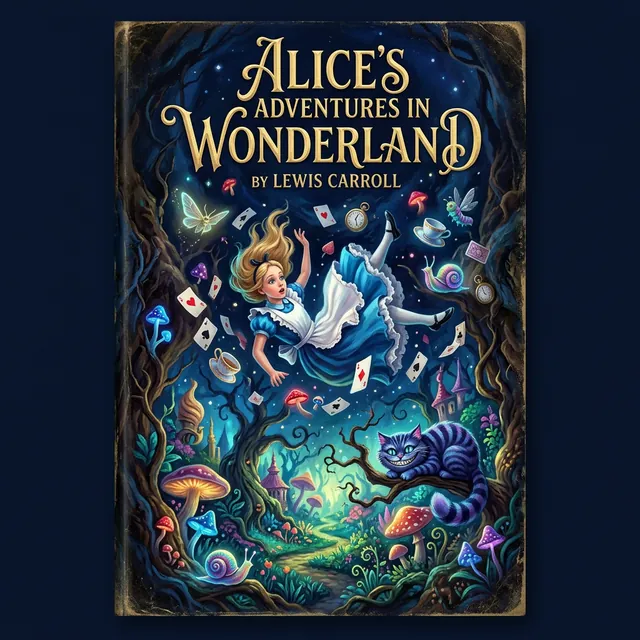
Alice's Adventures in Wonderland
Reading level: we suggest CEFR B1–B2 for reading Alice's Adventures in Wonderland. Length: about 27,000 words.
- Suggested levelB1–B2
- Lengthabout 27,000 words
- Original languageEnglish
The story
A bored girl follows a waistcoat-wearing White Rabbit down a hole and lands in a world where the rules keep changing. Bottles say “Drink me”, cakes say “Eat me”, and every sip or bite makes Alice grow or shrink at the worst possible moment.
Along the way she argues with a hookah-smoking Caterpillar, sits at a tea party that never ends, plays croquet with flamingos and finally stands trial before a Queen whose answer to every problem is “Off with their heads!”
Themes: curiosity, identity, logic and nonsense, growing up.
Why it's a good book for language learners
Carroll writes in short scenes built almost entirely on dialogue, so you meet a lot of everyday spoken English: questions, polite refusals, complaints and comebacks. The puns are the hard part — “tale/tail”, “lessons/lessen” — but working them out is a quick lesson in how English sounds trick the eye. When a joke goes over your head, a translation in your own language next to the line usually unlocks it.
How hard is the English in Alice's Adventures in Wonderland?
- Flesch Reading Ease81.0
- Flesch–Kincaid grade6.0
- Words per sentence16.3
Measured by PageWalker on the full English text of the book. Flesch Reading Ease runs from 0 to 100 (higher is easier; 60–70 is plain English) and the Flesch–Kincaid grade is a US school grade. These formulas only count sentence and word length, so they miss old-fashioned vocabulary, wordplay and style. That is why our CEFR level, which takes those into account, can be higher than the formula suggests.
What you'll practise
- Question forms and reported speech (“she asked whether…”)
- Comparatives: curiouser, larger, smaller
- Polite English: “Would you mind…?”, “I beg your pardon”
- Wordplay and homophones
Reading tip
Read the Mad Tea-Party chapter twice: once for the story, once only for the questions the characters ask each other.
Did you know?
The book began as a story Carroll improvised for the young Alice Liddell and her sisters on a rowing trip in Oxford in 1862.
Alice's Adventures in Wonderland: a part-by-part guide
Contains spoilers. Read one part of the book, then come back to check you followed it.
Chapters 1–2: Down the Rabbit-Hole and The Pool of Tears
Alice is bored on a riverbank with her sister when a White Rabbit with a pocket watch runs past. She follows it down a rabbit-hole and falls slowly into a long hall full of locked doors. She finds a tiny golden key, a bottle labelled DRINK ME that makes her very small, and a cake labelled EAT ME that makes her very tall. Too big to reach the garden, she cries a huge pool of tears. Holding the Rabbit's fan, she shrinks again, falls into her own pool and meets a Mouse.
Chapters 3–4: A Caucus-Race and The Rabbit's House
Wet animals climb out of the pool. To get dry, the Dodo organises a Caucus-race where everyone runs in a circle and everyone wins a prize. The Mouse tells a sad tale, but Alice keeps talking about her cat Dinah, and the animals leave. The White Rabbit thinks Alice is his servant Mary Ann and sends her to his house. There she drinks from a bottle and grows so big she fills the room. The animals send Bill the Lizard down the chimney, and later small cakes help Alice shrink and escape.
Chapters 5–6: Advice from a Caterpillar and Pig and Pepper
Alice meets a Caterpillar sitting on a mushroom. He asks her, 'Who are you?', and she cannot really answer. He tells her that one side of the mushroom makes her taller and the other side makes her shorter. Her neck grows very long, and a Pigeon thinks she is a serpent. Next she visits the Duchess, whose kitchen is full of pepper and whose cook throws things. Alice carries away a crying baby, but it turns into a pig. The grinning Cheshire Cat sends her towards the March Hare and the Hatter.
Chapters 7–8: A Mad Tea-Party and The Queen's Croquet-Ground
Alice joins the March Hare, the Hatter and a sleepy Dormouse at a strange tea-party. They ask riddles with no answers, make personal remarks and tell her it is always six o'clock, so it is always tea-time. Alice leaves angry and at last enters the beautiful garden. Card gardeners are painting white roses red. The Queen of Hearts arrives and shouts 'Off with her head!' at everyone. The croquet game uses flamingoes as mallets and hedgehogs as balls, and the Cheshire Cat's head appears in the sky.
Chapters 9–10: The Mock Turtle's Story and The Lobster Quadrille
The Duchess, now very friendly, walks with Alice and finds a moral in everything. The Queen then sends Alice with a Gryphon to meet the Mock Turtle, a sad creature who once was a real Turtle. He tells them about his school in the sea and the strange subjects he studied there. The Gryphon and the Mock Turtle then show Alice a dance called the Lobster Quadrille. Alice tries to recite poems, but the words come out wrong. The Mock Turtle sings 'Beautiful Soup' until someone cries that the trial is beginning.
Chapters 11–12: Who Stole the Tarts? and Alice's Evidence
The Knave of Hearts is on trial for stealing the Queen's tarts. The King is the judge, and twelve animals sit on the jury. The Hatter and the Duchess's cook give evidence, but nothing makes sense. Alice starts to grow bigger again. When she is called as a witness, she argues with the King and Queen. The Queen says, 'Sentence first—verdict afterwards.' Alice, now full-size, calls them nothing but a pack of cards. The cards fly at her, and she wakes up on the riverbank beside her sister. It was all a dream.
Main characters
- Alice: A curious and polite young girl who falls into Wonderland and keeps changing size.
- The White Rabbit: A nervous rabbit with a watch who is always in a hurry and works for the King and Queen.
- The Caterpillar: A calm, rude creature on a mushroom who asks Alice who she is and teaches her how to change size.
- The Cheshire Cat: The Duchess's cat, who grins widely and can slowly disappear until only its grin is left.
- The Hatter: A strange man who has an endless tea-party, asks riddles and later appears as a witness at the trial.
- The Queen of Hearts: The angry ruler of the card kingdom who orders people's heads to be cut off for small mistakes.
- The Duchess: A rough, ugly woman with a baby and a peppery kitchen who later becomes too friendly with Alice.
- The Mock Turtle: A very sad creature who tells Alice about his school in the sea and sings about soup.
Words to learn from Alice's Adventures in Wonderland
Each example sentence is copied from the book, so you will meet these words in exactly this form.
| Word | Meaning | In the book |
|---|---|---|
| remarkable | unusual or surprising enough to notice | There was nothing so very remarkable in that |
| curious | strange and unusual; also, wanting to know things | “What a curious feeling!” said Alice; “I must be shutting up like a telescope.” |
| anxiously | in a worried, nervous way | She ate a little bit, and said anxiously to herself, “Which way? Which way?” |
| puzzled | confused because you cannot understand something | Alice was more and more puzzled, but she thought there was no use in saying anything more till the Pigeon had finished. |
| indignantly | in an angry way because something seems unfair | “I’m not a serpent!” said Alice indignantly. “Let me alone!” |
| timidly | in a shy way, without confidence | Alice went timidly up to the door, and knocked. |
| sulky | quietly angry and unfriendly | “Well, be off, then!” said the Pigeon in a sulky tone |
| grins | smiles widely, showing the teeth | “why your cat grins like that?” |
| riddle | a question with a clever or funny answer | “Have you guessed the riddle yet?” the Hatter said, turning to Alice again. |
| executed | killed as an official punishment | She had already heard her sentence three of the players to be executed for having missed their turns |
| evidence | information a person gives in court about what happened | “Give your evidence,” said the King; “and don’t be nervous, or I’ll have you executed on the spot.” |
| verdict | the decision in a court about whether someone is guilty | “Consider your verdict,” the King said to the jury. |
Famous lines
“and what is the use of a book,” thought Alice “without pictures or conversations?”
“Curiouser and curiouser!” cried Alice (she was so much surprised, that for the moment she quite forgot how to speak good English)
“Oh, you can’t help that,” said the Cat: “we’re all mad here. I’m mad. You’re mad.”
“Well! I’ve often seen a cat without a grin,” thought Alice; “but a grin without a cat! It’s the most curious thing I ever saw in my life!”
“Begin at the beginning,” the King said gravely, “and go on till you come to the end: then stop.”
“No, no!” said the Queen. “Sentence first—verdict afterwards.”
Questions for discussion
Good for a book club, a class, or writing practice: answer one question in five sentences.
- Alice changes size many times in Wonderland. How do these changes make her feel, and what do you think they show about growing up?
- Many characters in Wonderland are rude or strange to Alice. Which character did you find the most interesting, and why?
- The Hatter asks a riddle that has no answer. Why do you think the book is full of games with words and logic?
- The Queen of Hearts often shouts 'Off with her head!', but almost nobody is really punished. What does this tell you about her power?
- The trial of the Knave of Hearts does not follow any normal rules. What is the author making fun of in this part of the book?
- At the end, Alice wakes up and learns it was all a dream. Did you like this ending? How would you change it?
The PageWalker adventure
In the PageWalker adventure you are Alice: every scene ends with a choice, and the wrong one can end your trip through Wonderland early. You can try the first page in your browser, and the adventure is available in 13 languages with click-to-translate.
Alice's Adventures in Wonderland in other languages
- EnglishAlice's Adventures in Wonderland
- العربيةأليس في بلاد العجائب
- DeutschAlice im Wunderland
- EspañolAlicia en el País de las Maravillas
- FrançaisLes Aventures d'Alice au pays des merveilles
- हिन्दीएलीस इन वंडरलैंड
- ItalianoLe avventure di Alice nel Paese delle Meraviglie
- 日本語不思議の国のアリス
- 한국어이상한 나라의 앨리스
- PortuguêsAs Aventuras de Alice no País das Maravilhas
- РусскийАлиса в Стране чудес
- TürkçeAlice Harikalar Diyarında
- 简体中文爱丽丝梦游仙境
Questions about Alice's Adventures in Wonderland
What reading level is Alice's Adventures in Wonderland?
We suggest CEFR B1–B2 for reading Alice's Adventures in Wonderland. Carroll writes in short scenes built almost entirely on dialogue, so you meet a lot of everyday spoken English: questions, polite refusals, complaints and comebacks. On readability formulas the English text scores a Flesch Reading Ease of 81.0 and a Flesch–Kincaid grade of 6.0, with an average of 16.3 words per sentence.
How long is Alice's Adventures in Wonderland?
Alice's Adventures in Wonderland by Lewis Carroll (1865) is about 27,000 words.
Can I play Alice's Adventures in Wonderland as an interactive adventure?
Yes. In the PageWalker adventure you are Alice: every scene ends with a choice, and the wrong one can end your trip through Wonderland early. You can try the first page in your browser, in 13 languages.
Updated 16 October 2026